WaterCalcLab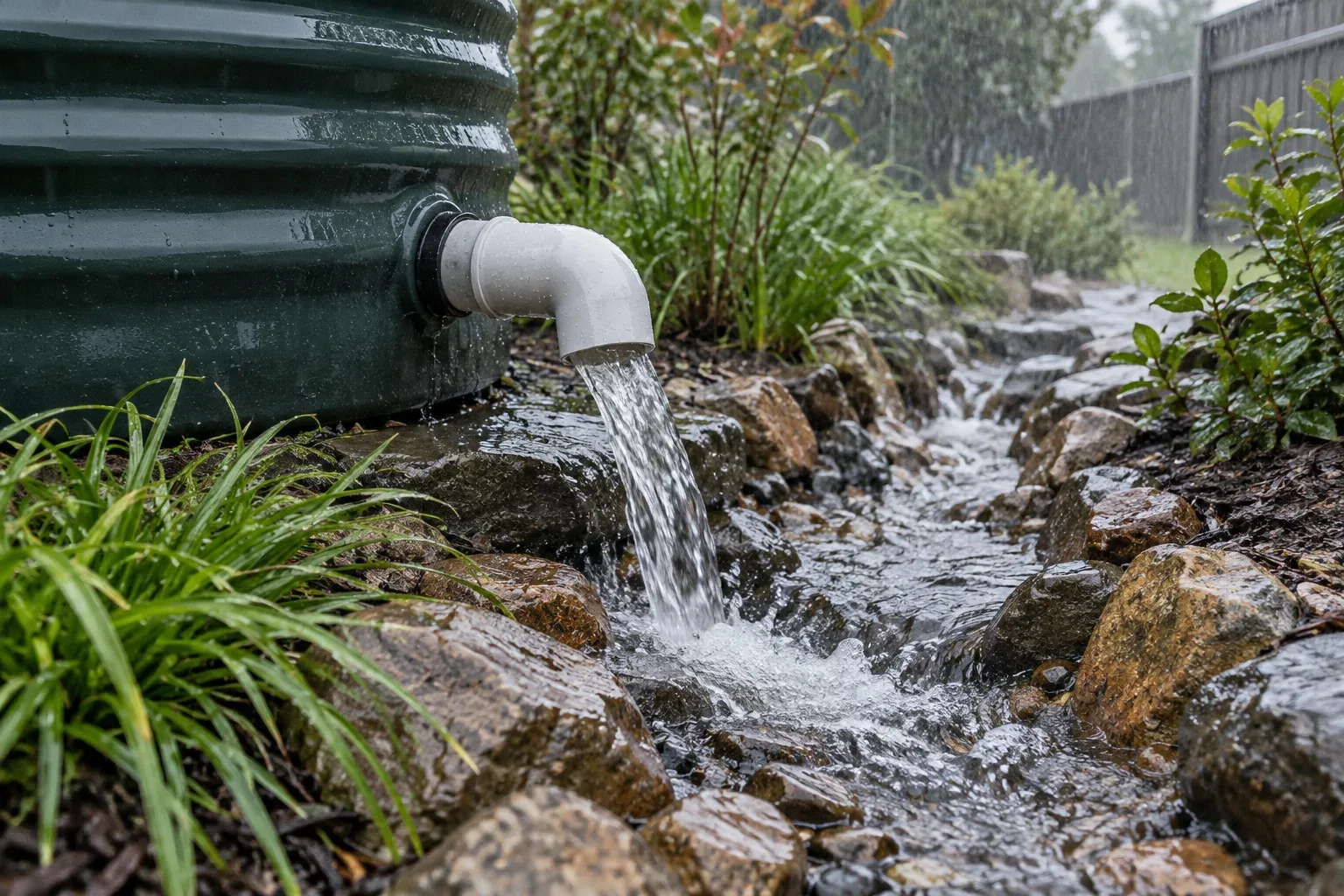
Overflow is part of normal operation
A collection system needs somewhere for incoming water to go after the tank reaches its operating limit. Plan that route from the start rather than treating every overflow as a malfunction. Distinguish a full-tank overflow from water escaping at a blocked gutter or inlet; the latter can occur even while substantial storage space remains available.
Compute event overflow from available space
An illustrative event produces 900 litres of tank inflow. A 1,000 litre tank starts with 600 litres and has 400 litres free. If no water is withdrawn while rain arrives, it retains 400 litres and passes 500 litres to overflow. An empty tank receiving the same inflow would retain all 900 litres. Starting level is essential to the calculation.
Total overflow volume does not specify the required pipe diameter.
1,000 L capacity, 600 L starting volume; no simultaneous withdrawal.
Volume does not size the overflow pipe
The 500 litre result describes a total amount, not a peak flow rate. The same amount arriving over five minutes or two hours creates very different hydraulic demands. Pipe sizing needs rainfall intensity, contributing area, connection geometry, gradients and local design requirements. The event calculator cannot approve pipe diameter or guarantee flood protection from a volume total.
Choose a lawful, safe destination
Assess the receiving drainage arrangement with local requirements and site conditions. Avoid uncontrolled discharge beside foundations, onto a neighbouring property or across a slippery walking route. Infiltration may be an option only where soils, groundwater, setbacks and regulations permit it. Keep the discharge route identifiable so later landscaping does not accidentally obstruct it.
Interpret overflow when expanding storage
Frequent overflow does not by itself prove that a larger tank is worthwhile. Check whether the extra water would be used before the next event. If demand is low and the tank remains almost full, expansion may simply postpone overflow. Compare retained useful withdrawals in a time-series model rather than treating every overflow litre as an attainable saving.
Overflow checklist
- Record starting level.
- Calculate free space.
- Separate inflow from peak flow.
- Identify a permitted destination.
- Check inlet and outlet blockages.
- Inspect the route after landscaping.
- Assess useful demand before enlarging storage.
- Obtain site-specific drainage advice where flooding consequences are significant.