WaterCalcLab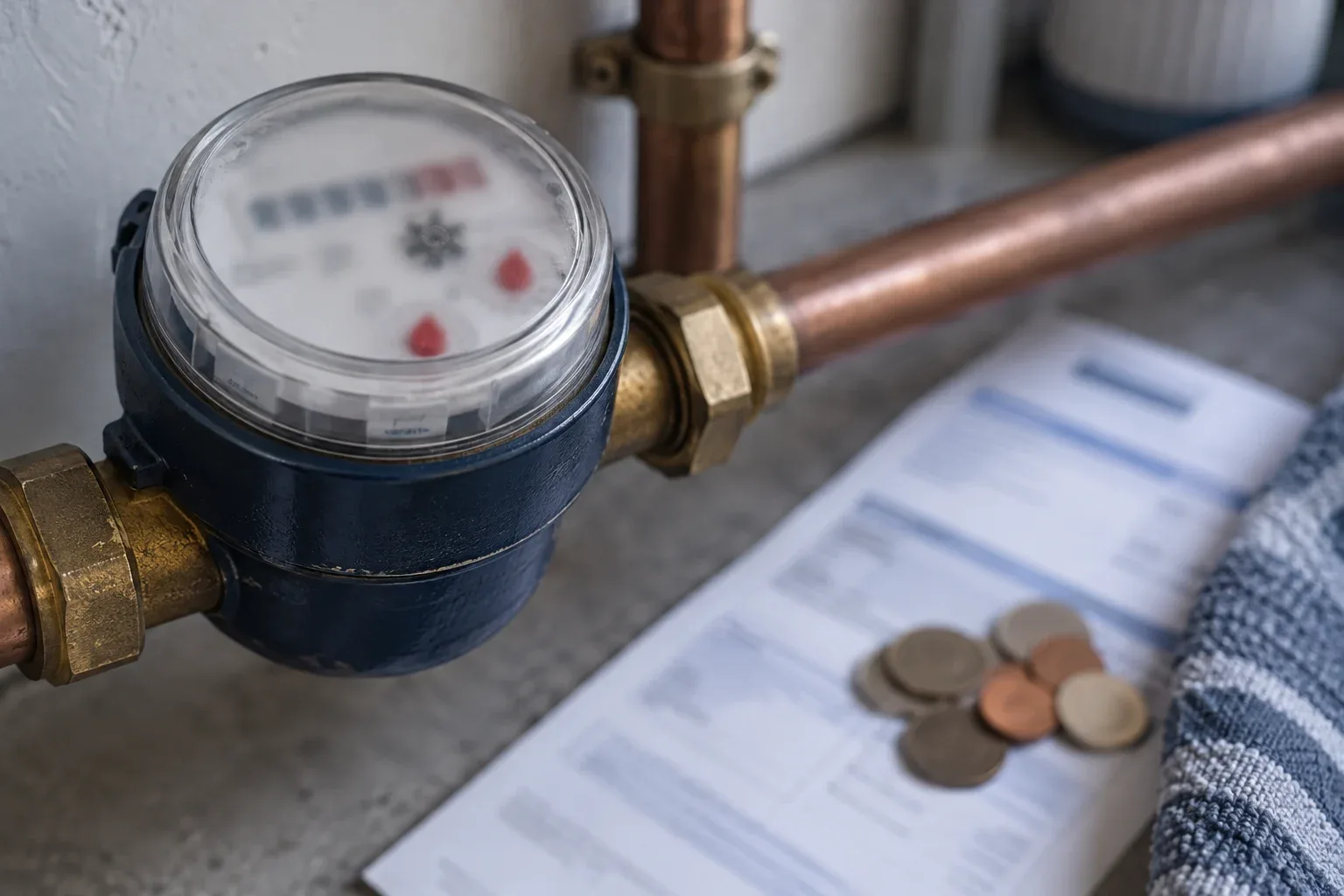
Read the bill structure before estimating
Find billed volume, billing period, volume units, fixed charges and the consumption-dependent tariff. Check whether water and wastewater appear separately. Utilities can use cubic metres, gallons or other billing units. Convert the volume first, then calculate cost. A bill total divided by volume may be an average paid rate, but it is not necessarily the rate avoided by using one less unit.
Separate fixed and variable charges
A fixed service charge usually remains when consumption changes within the same connection arrangement. Variable charges may be flat or tiered. Identify which entries are actually affected by the planned water saving and verify locally rather than assuming a universal wastewater rule. Preserve the source tariff or bill date because the result depends on those specific prices.
The saving is 37.50; the unchanged fixed fee is not avoided.
Uniform variable tariff 2.50/m³ and fixed annual fee 60; illustrative currency-neutral prices.
A flat-tariff illustration
For an illustrative annual use of 80 m³, a variable charge of 2.50 currency units per m³ and a fixed annual charge of 60, total cost is 80 × 2.50 + 60 = 260. Cutting use to 65 m³ gives 222.50. The saving is 37.50, not 48.75 from multiplying the 15 m³ difference by the original average bill rate of 3.25.
Tiered prices need two bill calculations
Assume the first 50 m³ cost 2 per m³ and further consumption costs 4. At 70 m³ the variable bill is 100 + 80 = 180. At 55 m³ it is 100 + 20 = 120. Saving 15 m³ avoids 60 in this scenario because it removes upper-tier use. A single average price would hide that relationship.
Add operating costs consistently
Rainwater pumping, maintenance and treatment where applicable can affect net benefit. Keep these costs separate from the utility bill calculation. Use measured or documented electricity consumption where possible, and state assumptions otherwise. A currency-neutral example is transferable arithmetic; it is not a claim about the price or affordability of water in your location.
Water-cost checklist
- Check volume units.
- Preserve tariff date.
- Distinguish fixed and variable entries.
- Confirm wastewater treatment in the bill.
- Model price blocks.
- Calculate both scenarios.
- Include relevant operating costs.
- Show currency.
- Avoid presenting the average total bill rate as automatically avoidable.