 WaterCalcLab
Water Consumption Calculator
Scale a measured or selected per-person use over a period.
Your result
Bars compare only results in the same unit group. They are normalized, not a time-series forecast.
Planning result based on your inputs.
How this tool works
Scale a measured or selected per-person use over a period.
V = people × litres/person/day × daysExample calculation
The prefilled form is a worked example. Its base-unit inputs and expected outputs are shown below; use the reset button to restore it.
| Input | Example |
|---|---|
| Number of users | 4 |
| Use per person per day | 100 |
| Days | 21 |
Planning notes for this calculator
Scale a per-person daily consumption estimate across a group and period. Use it for a transparent demand scenario, then compare the result with actual meter readings.
Choose meaningful inputs
- Number of users
- Use the number of people present for the whole modeled period. Split changing occupancy into separate periods.
- Use per person per day
- Use measured litres per person per day for the included uses. The preset is not a population average.
- Days
- Match days to the occupancy and measurement period. Partial days can be modeled when appropriate.
Read the result correctly
Daily total is users multiplied by per-person use; the period total multiplies that by days. The model assigns the same daily use to each person. Garden irrigation, leaks or shared equipment may not scale with occupancy and should be identified separately. When deriving a per-person figure from a meter, note which shared uses are already included.
Common mistakes to avoid
- Do not add garden demand again if it is already included in your measured per-person figure.
- Compare equal occupancy and dates when judging improvements.
A useful next step
Record opening and closing meter readings, dates and occupancy, then compare measured and modeled totals.
Follow a worked scenario
A separate illustrative scenario; these values do not change when you edit the form above.
- 4 people × 100 L/person/day = 400 L/day.
- 400 × 21 days = 8,400 L, or 8.4 m³, over the period.
Frequently asked questions
Is 100 litres per person a recommended allowance?
No. It is an illustrative input. Your measured use depends on the included activities, fixtures and occupancy. State those boundaries before comparing households or planning capacity.
What if occupancy changes during the period?
Calculate each period of consistent occupancy separately and add the volumes. This makes the assumption visible instead of attributing every day to one fixed group size.
Continue your plan
Rainwater Tank Size Calculator
Size usable storage for a chosen rainless interval and compare annual supply with constant annual demand. Rainfall here must be annual.
Open calculator ↗Water storageRainwater Storage Duration Calculator
Divide usable storage by a constant daily demand to estimate rainless supply duration.
Open calculator ↗Water storageWater Tank Volume Calculator
Calculate exact geometry from internal dimensions for a vertical cylinder, box or sphere.
Open calculator ↗Related reading
 Costs & savings
Common Water Waste Problems
Unexpected bills, damp areas, dripping fixtures and irrigation running after shutdown can signal unnecessary consumption. Start with an observation log including time and which equipment was operating. Avoid assuming every damp patch is a pipe leak; rainfall, drainage and other causes can produce similar symptoms. Investigate systematically before choosing a repair.
Read guide ↗ Water storage
How Long Does Stored Rainwater Last?
The question has two meanings: how long a volume can supply demand and how long water remains suitable for a particular use. Only the first can be answered with a simple volume calculation. Suitability depends on source water, storage conditions, treatment and exposure. A calculator showing a number of days is not a water-quality expiry date.
Read guide ↗ Costs & savings
Water Conservation at Home
List regular activities and any fixtures or equipment involved. Record occupancy and separate indoor use from irrigation where possible. Meter readings reveal the whole-home total; event measurements explain where it goes. Focus first on avoidable use that can be changed without compromising necessary hygiene, health or the performance of essential equipment.
Read guide ↗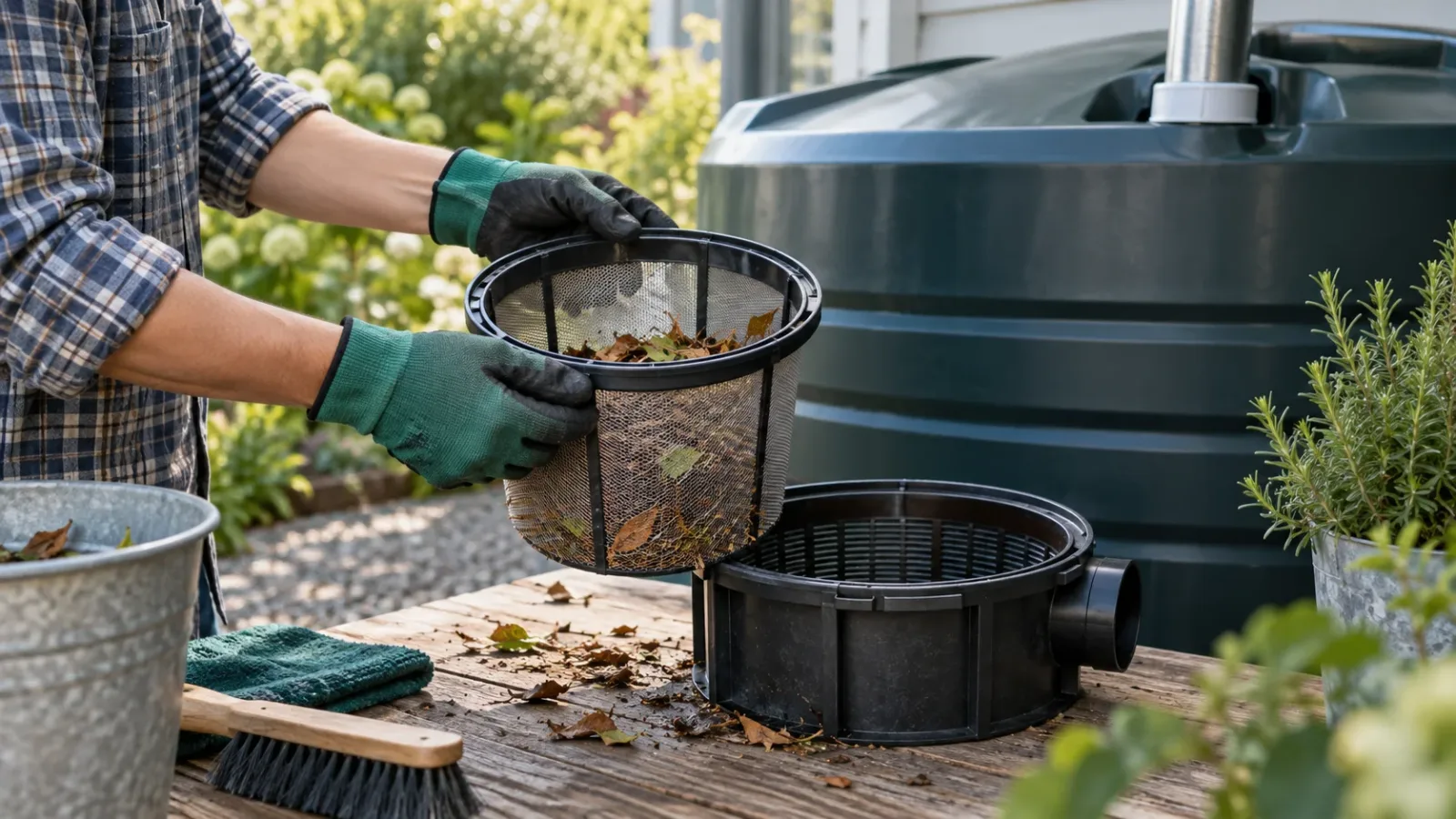 Water storage
Rainwater Tank Maintenance
List installed components, manufacturer instructions, inspection access and the person responsible for each task. Include the roof collection route, screens, tank, overflow, valves and delivery equipment. A maintenance plan should make a fault easy to identify and isolate. Follow product requirements rather than adopting an unsupported universal cleaning interval for every climate and use.
Read guide ↗Sources & method references
- US EPA WaterSense: Understanding your water bill
Volume units and billing structures. Enter your own applicable supplier prices.
Method version 1.1 · Example documentation dated: 2026-10-11